Which of the Following is Expected to Continue to Be an Advantage of Traditional Radio
Printed from: https://jacobsmedia.com/rapidly-changing-face-radio-listening/ on 10/22/2022
Yesterday's post illustrated the changing distribution environment for broadcast television content. From cord-cutters to heavy on-demand users, consumers are redefining the ways in which they're watching "TV." And we saw indicators that many of the same people moving rapidly to on-demand video delivery channels also tend to be regular podcasting users.
Thus, it's not much of a leap to assume the rapidly changing content consumption trendline in television is already making its way over to radio. The big TV networks have begun to accept these sweeping changes as the real deal, as they focus more on monetizing streaming and on-demand formats.
On the radio side of the spectrum, the on-demand wave isn't as sweeping – yet. But our newest Techsurvey suggests more people are listening to "radio" without using a traditional AM/FM radio.
We have been tracking usage to our stakeholder radio stations, and this year we had a record-setting base of more than 560 stations. That tells us there's growing interest – and concern – in the radio business about tech trends and how they impact broadcast radio today – and will continue to do so in the future.
In one question series, we ask respondents to think back to the prior week to recall how they listened to the stakeholder station. We provide them with the many different platforms from which consumers can now access "radio,' and ask them to use percentages to tell us how they use the various distribution outlets now available to them.
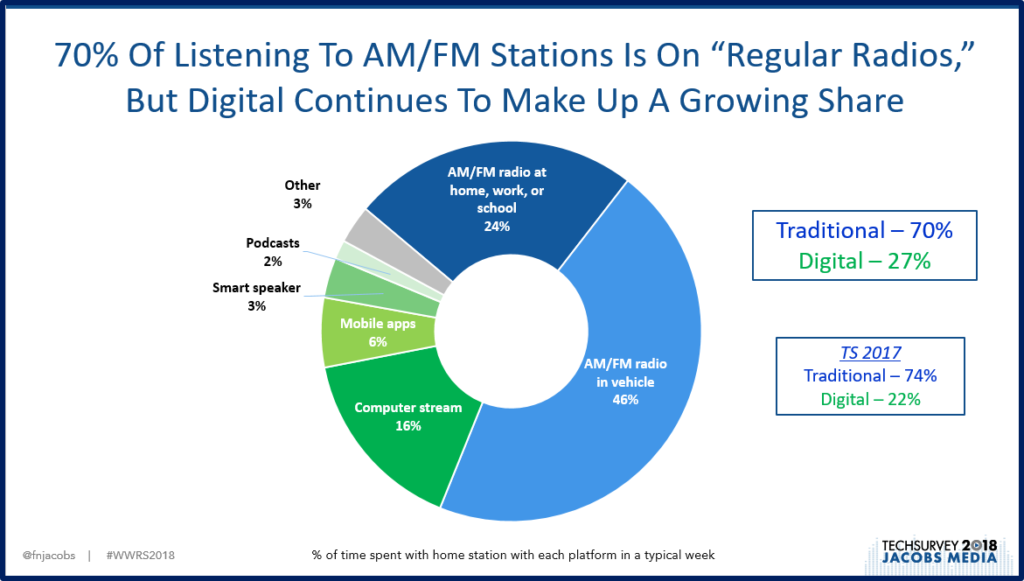
The "blue slices" represent traditional radio listening on "regular radios." In TS 2018, that adds up to 70% of consumption, versus 27% of listening on digital platforms – computer streaming, mobile apps, podcasts, and yes, even smart speakers. They continue to add up, providing us with a glimpse of where the digital puck is moving.
And when you isolate certain audience groups – like Millennials – the digital share of broadcast radio consumption runs even higher. The same is true among format fans of Alternative, Sports, and others.
But this is not a static chart. I've included last year's stats where the traditional:digital ratio was 74%/22%. And in fact, this shift away from traditional and toward digital listening has been going on even longer than that. The chart below shows the 6-year trend, and the trajectories are difficult to miss or misinterpret:
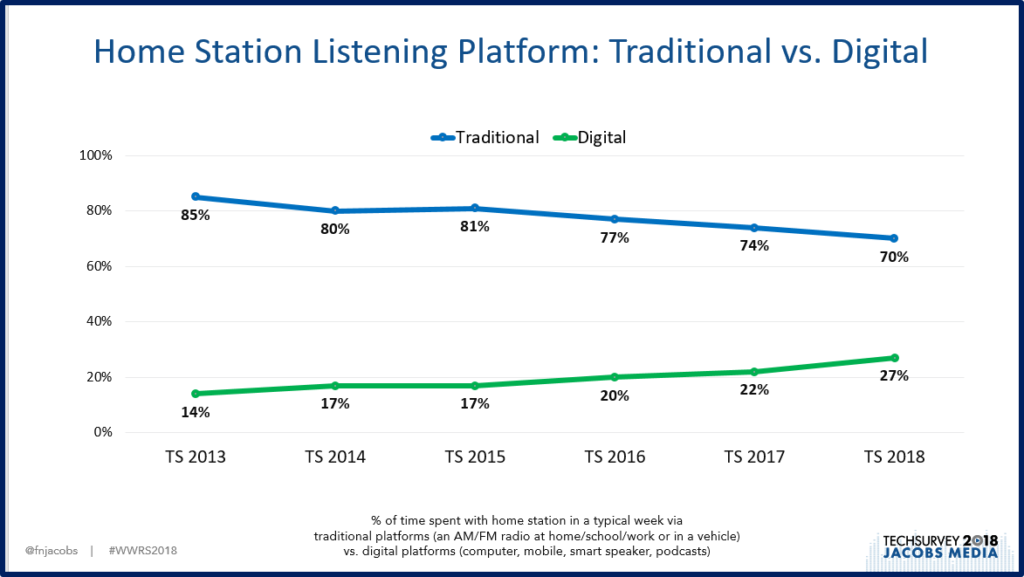
And keep in mind you're looking atcore radio listeners.Yes, they may be a bit ahead of the curve by virtue of being online, and (for the most part) members of radio station email databases. But they are some of the most ardent fans radio stations have. To see these lines inching closer and closer together with each passing year is a reminder to radio companies of the critical need to have a coherent, realistic digital strategy in place.
It's also more evidence that what TV is experiencing, radio is already following in its digital footsteps. Last weekend,The New York Timesran a story illustrating the demographic shift in overall usage that's taking place. Aggregating Nielsen data, this accompanying chart speaks volumes about why TV is struggling, and why radio is heading down the same rabbit hole. Yes, I added the arrow.
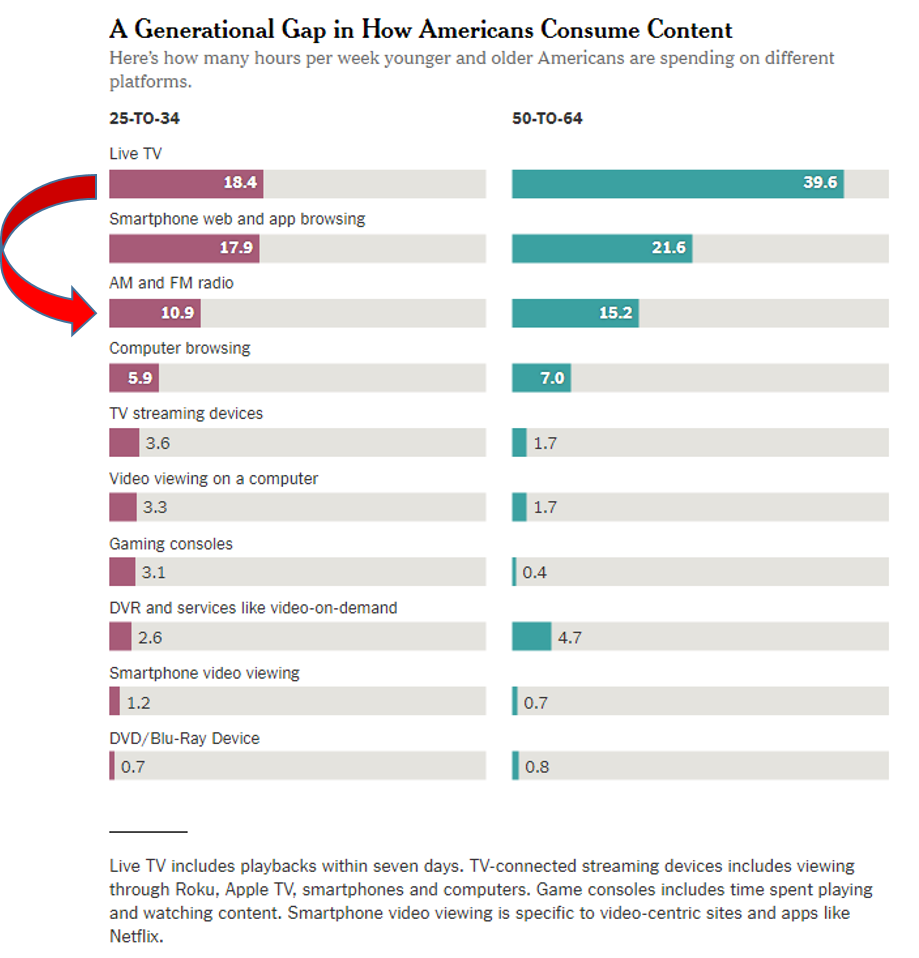
On the television side, on-demand is much, much more of a game-changing consumption trend, thanks in large parts to TiVos more than a decade ago right up to Netflix, Hulu, YouTube, and other video streaming sources today.
While podcasting – or on-demand audio – continues to grow every year, its impact pales in comparison to the tectonic shift that's occurred in television. But the foundation of this media consumption trend is in place, and audio will most definitely follow suit.
 As we've long concluded after each of the last several Techsurveys, the digital toothpaste is indeed out of the tube. Whether radio promotes its digital assets (and yes, it should) or not, consumers are gravitating to new distribution platforms.
We all have our jobs to do. But data like this compels us to look up from our music scheduling screen, our Q3 sales forecasting, and our transmitter maintenance to continue to process how these shifts affect listening and usage today – and how it will continue to do so next year and the year after.
There's a lot here to digest, but it all starts with the disruptive media change that is all around us. Yes, measurement of these new consumption outlets is a must, as is the ability to communicate radio's expanding strengths to an advertising community that is rapidly being rocked itself by change and disruption.
As attribution models become more reliable and consistent, radio may find itself in a position to better cash in on the digital wave, while owning  powerful data sets it can manage and control.
It's hard to believe the next couple years won't portend even more change. For those of us lucky to be working in the radio business during this fork in the road, new heroes, models, and innovations will surface to provide the industry with new potential and hope.
Radio stations will be saying, "Thanks for listening to us – wherever you are, on whatever device you choose, and whenever you like."
And the industry will be happily providing content on these sources, thankful to be able to participate in the digital wave. As we heard yesterday from management and talent – NBC's Bob Greenblatt and ABC's Jimmy Kimmel – these emerging digital platforms are keeping traditional media alive, vital, and relevant.
Radio will need to get its arms around on-demand, and that's another reason why we're so immersed in the Podcast Movement  conference. This year, it takes place in July in Philly. Jacobs Media's "Broadcasters Meet Podcasters" two-day track will focus on how radio execs, producers, and talent can develop successful on-demand strategies.
Next week, we'll release our agenda, chocked full of some of the biggest names in both podcasting and broadcasting.
Info here.
- Author
- Recent Posts

Fred Jacobs founded Jacobs Media in 1983, and quickly became known for the creation of the Classic Rock radio format.
Jacobs Media has consistently walked the walk in the digital space, providing insights and guidance through its well-read national Techsurveys.
In 2008, jacapps was launched - a mobile apps company that has designed and built more than 1,300 apps for both the Apple and Android platforms. In 2013, the DASH Conference was created - a mashup of radio and automotive, designed to foster better understanding of the "connected car" and its impact.
Along with providing the creative and intellectual direction for the company, Fred consults many of Jacobs Media's commercial and public radio clients, in addition to media brands looking to thrive in the rapidly changing tech environment.
Fred was inducted into the Radio Hall of Fame in 2018.
Latest posts by Fred Jacobs (see all)
- Are You Following The Radio Rules? - October 21, 2022
- Radio's Pre-Existing Conditions - October 20, 2022
- Well, Thank YOU! - October 19, 2022
Source: https://jacobsmedia.com/rapidly-changing-face-radio-listening/
0 Response to "Which of the Following is Expected to Continue to Be an Advantage of Traditional Radio"
Post a Comment